
Chinese Naan, Red-Braised Pork Ribs and Toasted Sesame Oil
Along the Silk Road
Like almost every other Asian I grew up eating naan, except that we call it 烧饼 which means baked flatbread. Now just for accuracy I should mention, 烧饼 is a slightly different thing up north on the other side of the Yangtze River. But at least on the Hang-Jia-Hu Plain in the Southern Yangtze Delta of China, for as long as people can remember, we eat naan for breakfast or as a snack in the afternoon if dinner is late. You grab one from a little food stall in your local farmers’ market, either on your way to school/work or back home.
Watching naan getting made is delightful. Doughs are rolled and put into a vertical oven. You feel the heat from the charcoal, watch the bread rise, and anxiously wait for that piping hot flatbread which you will devour in a few seconds. We apply a bit of our own twist to this Eurasian classic. Our naan dough is mixed with lard, green onion and sesame, and is rolled as thinly as possible. So instead of a soft bread to which you can apply garlic and butter, it has this toasted sesame flavour. And because of lard, it’s extra crispy which makes it a kids’ favourite and the ultimate comfort food in my opinion.
When I left my hometown for university, I became aware of and fascinated by the fact that Muslims in the west of China, being Hui, Kazakh or Uygher, call the exact same thing 馕(nang/naan), which I later found out is directly borrowed from its original name in Persian.
I cannot believe that there hasn’t been proper books written about how naan makes its way through the Silk Road and ends up in the east most part of China. And even more interestingly, why in places like Beijing which is closer to the Silk Road, 烧饼 means a completely different thing. But that’s not the story today.
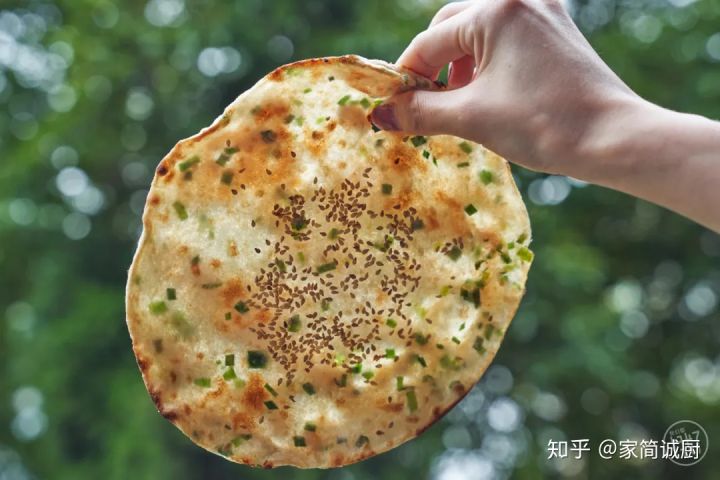
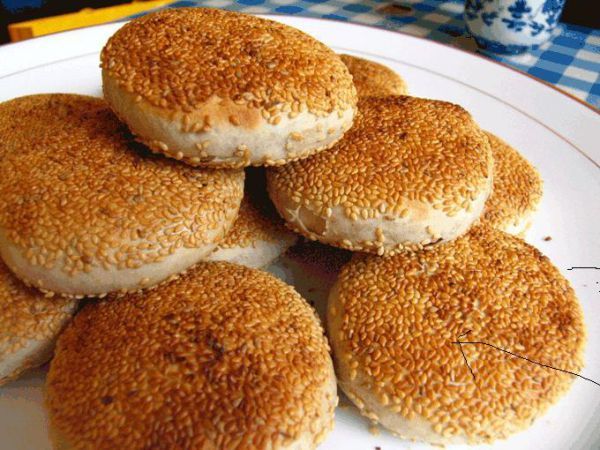
烧饼 from my hometown of Huzhou(left) and 烧饼 in Beijing(right)
Pork Ribs for dinner
Everyday after the school ended, I would be walking home with my grandpa and we would walk past that market and that naan stall to spend an equivalent of 15 pence for a naan bread. Instead of shawarma, we wrap 油条, stinky firm tofu, deep fried Taiwanese sausage or Taiwanese popcorn chicken with it. But my grandpa never allowed me to have those toppings. Deep fried food from a food stall is considered suspicious by him, since they don’t change the frying oil frequently enough. I never envied other kids for having those fillings though. “We have better food at home”, as grandpa always says.
His signature dish is red-braised pork ribs. Porks ribs are chopped into small pieces, shallow-fried in oil to dehydrate and to have that nice maillard effect. Then, it is deglazed and braised in soy sauce with some spices to slowly reduce. Unlike the Chinese national dish of sweet sour ribs, it is much more regional, richer in flavour and my grandpa’s version is just the best. The dehydration opens up space for flavours to penetrate, and he knows just the right ratio between soy sauce, suger and spices to fill that open space. His cooking was unparalleled, spoiling my dad and my aunt since they were kids, and sometimes also the extended family. Every Chinese New Year, we would host a banquet at home, with three or four families, and with every dish cooked by grandpa.
He was the backbone of the family in terms of all three meals and was extremely picky on food. He often even insisted on buying all the ingredients himself, because my mom and my grandma “don’t know how to pick the best ones”. For a man of his age, he has that universal thing where he always needs to be tough, be self-dependent and always be right. An example on food is that he really likes to finish with a touch of toasted sesame oil, which sometimes we find a bit unfitted to some dishes. A worse example is that he sometimes refuses to take his prescription for diabetes, as he believes more in traditional herbal medicine.
A story of my grandpa, and China in general
I never blamed him for that because he learnt his lessons the hard way. Born in the nearby city of Shaoxing, he says he grew up in a quite cultured family. That however was not a blessing but a curse, since he grew up during the Japanese invasion, and locally influential families were targets of either collusion or persecution during occupation. They fled into the mountains of Jiangxi province, and as he told those stories, “hid in the potato fields all day dodging bombs”.
I never knew exactly what happened. But as far as I can collect from his stories, when WWII ended he and his elder brother were the only ones left in the family. Without anyone to rely on, they sought asylum from a distant relative in the provincial capital of Hangzhou, working and trying to get educated.
At that time the ruling party of China was Kuomingtang, a brutal nationalist dictatorship backed by the US. Living in an urban city among the suffering working class people, naturally they got “radicalised” and his brother secrectly joined the Chinese Communist Party. The underground institution of CCP helped sending out propaganda leaflets, organising strikes and sabotaging the millitary infrastructure, which eventually collapsed the Kuomingtang rule during the Chinese civil war.
But the CCP is not as revolutionary as they thought but quite the opposite. Mao might write all the pretty words outlining his theory of Communism, but deep down he bore the exact same way of thinking as all Chinese emperors before him: If you can betray another emperor, one day you’ll betray me as well.
Hence began the first of many cleansings during Mao’s era, which targeted “any potential remnants of anti-revolutionary forces”, and especially “double agents”. More than 700000 were executed in a swift manner, and millions associated with them were labelled “anti-revolutionary”, barred from decent employment and higher education. Among those dead was my grandpa’s only close family member, and he got his badge of shame, a label of “anti-revolutionary” in his documents.
Grandpa had nowhere to go. His remaining relatives had to cut ties with him to save themselves from the labelling, and he was merely 18 (plus/minus one since I never know exactly). The only places “hiring” people like him were labor camps, in which they were building millitary airports preparing to invade the last stronghold of Kuomingtang, the island of Taiwan.
Now in fairness, it was slightly better than a Soviet Gulag. He got enough sleep and food, and even attended night school which eventually granted him a job working in a factory. After the Korean war broke out, the US decided to intervene the Taiwan strait warfare to prevent losing the island as a strategic point. The communists realised after that they had to give up the plan for invading Taiwan, and closed those labor camps.
Since then my grandpa worked in a small factory in the countryside of Huzhou. He eventually married a local, and settled down. His Shaoxing dialect of Taihu Wu got assimilated by the Huzhounese dialect. And he embraced the soy sauce heavy cuisine in the Taihu region and started to identify himself as a Huzhounese. He stopped writing to his extended family in Hangzhou. But there is one thing he never left behind, which is the execution of his brother. He wanted to restore his brother’s reputation, get the case overturned and make the government recognise his brother as a martyr of the revolution. That never went away.
The Bucket List
But the thing is, they couldn’t find any documents for that insignificant case during a chaotic time, let alone review it. He trie d various ways in vain and eventually all family members were telling him to let go. The frustration got him very upset over the years of trying and closed him away from intimate relationships, which led to him doing everything on his own.
That became worse when he had a medical condition and had to let my dad cook for the family. He refused to go out, to the point we had to pay barbers to come to get his haircut; He refused to recognise my dad as an equally excellent cook, as that was his thing when he were healthy.
But he liked the fact that I am now cooking for myself. I never get the chance to cook for him at home since my dad is 100 times better and I was supposed to “focus on study not chores”. After going to UK, I constantly sent pictures of the food I made to him, saying that I would go back to cook all these stuff for him. He liked the idea.
Then the pandemic came, and my return flight was infinitely postponed. I became extremely homesick, and the health of grandpa deteriorated real quick. Preparing for the ultimate goodbye became a real issue. I had to actively think what is the most vivid memory of me and grandpa, as a way to remember him.
And it is the daily afternoon walk from school to home, with me holding a naan to eat. I was thinking to get a small oven when I go back and make that for him, as a toast to the good old days before it’s too late.
The Fifth Seven, and the Seventh Seven
In China we believe in reincarnation. After someone passed away, the soul lingers the earth for another 35 days, called the Fifth Seven (五七). And then this person left for the underground world to be reassigned into a new-born life, in the 49th day, called the Seventh Seven (七七). The exact date of this varies across China, but the end of the story is the same: The god in charge of this, 阎王爷, will assign each dead being according to their goods and bads to a new life. Before your departure to the living world, 孟婆 will give you her special soup, which will make you forget everything in your past life to start fresh.
Sometimes we joke about how that’s going to be the ultimate relief for my grandpa, away from politics, war and the biggest regret of his life, which is failing to protect the reputation of his family.
On Sept. 8th, 2020, my grandpa gave in to cerebral thrombosis and induced diseases after almost 13 years of battling. My dad figured for a though man like him, his lingering soul will not like the idea of people crying and saying sentimental things about him. So for the first 35 days, we only told the close family members. And we will not get too attached before he forgets everything and moved on to his next life.
Finally, let go
I’ve been writing this for the past few weeks, from bits and pieces and winding into this final little story that I want to tell. It’s in English because I think since my grandpa can’t read it, he won’t be upset by his grandson too emotional. For the last part of his life, he deserves all the happiness. I want him to think that I’m doing extremely well, eating all the amazing food at the other side of the world. I’d like to think he will be drinking that soup and let go with a happy face.
But I for one am left with the memories and emotions that were carved into me. I still remember that day, about 13 years ago, when we walked home together. I was not allowed a naan because I had it yesterday, and just when we walked past that market and across the street, he fell over. He wasn’t injured and didn’t look in anyway troubled by it. Being him, he told me not to tell anyone about this because it would make him lose face. I was 9 and fell down a lot myself, and was getting some laughed-at by my classmates from time to time. Being a kid and not understanding the difference between me and an adult falling over for no reason, I said yes.
A few months later he fell over again and never recovered from it. We discovered that a long time ago a clog in his brain was already affecting him a bit which should be identified earlier. It eventually developed into cerebral thrombosis and paralysed the right half of his body.
I’ve hated myself a lot ever since that day, watching him become older and older, sufferring from isolation, hearing loss and many other physical and mental health issues, thinking that at least part of it was on me. I don’t really believe what my ancestors believe, but I think there’s no point of me still hating myself for that after he forgets everything, one way or another. So I will look forward to the first 烧饼夹油条 since I leave for UK after I finally get to sweep his tomb in the future. And I will let go, with burning incense, a few kowtows and those memories of weekday afternoons.